Download Light Scattering Reviews 10: Light Scattering and Radiative Transfer - Alexander A. Kokhanovsky | ePub
Related searches:
Protein analysis by dynamic light scattering: methods and - PubMed
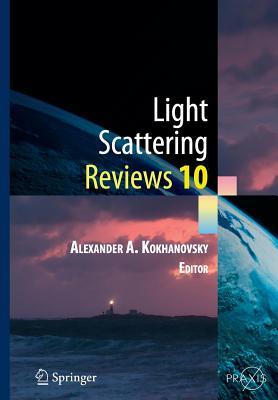
Light Scattering Reviews 10: Light Scattering and Radiative Transfer
Nonlinear Light Scattering and Spectroscopy of - Annual Reviews
Light scattering and surface plasmons on small spherical particles
Michael I. Mishchenko: Books on Electromagnetic and - NASA GISS
Light Scattering Reviews 10 - Light Scattering and Radiative
Light scattering reviews. 10, Light scattering and radiative
Light Scattering Reviews, Vol. 6 - Light Scattering and
Static and dynamic light scattering by aqueous polyelectrolyte
Light Scattering and Thermal Emission by Primitive Dust Particles in
Light Scattering Reviews 8: Radiative transfer and light scattering
Springer Praxis Books: Light Scattering Reviews 10: Light
The Scattering of Light and its Applications to Chemistry
Light scattering and the absolute characterization of
Study of Light Scattering by TiO2, Ag, and SiO2 Nanofluids
Pubs.GISS: Hansen and Travis 1974: Light scattering in
NASA GISS: Electromagnetic and Light Scattering by Small
Tissue Optics: Light Scattering Methods and Instruments for
Raman Techniques: Fundamentals and Frontiers Nanoscale
Scattering And Absorption of Light in Planetary Regoliths
2504 2674 22 4964 2144 564 2845 1213 4384 4809 3637 1444 4197 4123 185 1545 2522 3304 146 1625 4310 4213 3500 4596 4226 2540 78 1699 2046
This third edition of the biomedical optics classic tissue optics covers the continued intensive growth in tissue optics—in particular, the field of tissue diagnostics and imaging—that has occurred since 2007.
May 21, 2020 we report the results of a laser light-scattering experiment in which speech- generated droplets and their trajectories were visualized.
Nano review open access characterization of magnetic nanoparticle by dynamic light scattering jitkang lim1,2*, swee pin yeap1, hui xin che1 and siew chun low1 abstract here we provide a complete review on the use of dynamic light scattering (dls) to study the size distribution and colloidal stability of magnetic nanoparticles (mnps).
This webinar reviews light scattering technology and instrumentation, then presents how light scattering solutions can be used in research.
Kokhanovsky; isbn: 978-3-662-46761-9; authors: george w kattawar.
Jun 6, 2014 here we review the fundamental aspects of light scattering by small potential practical uses include small-scale sensing techniques,.
The work is aimed at the review of hot topics in modern light scattering and radiative transfer. A special attention will be given to the description of the methods of integro-differential radiative transfer equation solution. In particular, the asymptotic radiative transfer and the method of discrete ordinates will be considered.
Driven by applications in chemical sensing, biological imaging and material characterisation, raman spectroscopies are attracting growing interest from a variety of scientific disciplines. The raman effect originates from the inelastic scattering of light, and it can directly probe vibration/rotational-vibration states in molecules and materials.
Stanford libraries' official online search tool for books, media, journals, databases, government documents and more.
20644 abstract dynamic light scattering (dls) analyses are routinely used in biology laboratories to detect aggregates in macromolecular solutions, to determine the size of proteins, nucleic acids, and complexes or to monitor the binding of ligands.
Using full-wave numerical simulations and analytical multipole expansions, we investigated the properties of real-space polarization singularities that emerge in light scattering by subwavelength particles. We considered spherical and torus particles under the excitation of a linearly polarized plane wave. We determined the topological indices and the trajectories of electric-field.
Numerical techniques in single and multiple l the architecture of light: architectural lighting design concepts.
When light passes from one medium to any other medium say air, a glass of water then a part of the light is absorbed by particles of the medium preceded by its subsequent radiation in a particular direction.
Buy springer praxis books: light scattering reviews 10: light scattering and radiative transfer (hardcover) at walmart.
In this review, recent developments in the use of laser based techniques to isolate and manipulate single particles and to characterise them will be highlighted. In particular, the use of cavity ring down spectroscopy, bessel beams and optical tweezers for investigating light extinction, scattering and absorption, respectively, will be considered.
This book is divided into 10 chapters that particularly present examples of light scattering review (vol 8) is aimed at the presentation of recent advances.
This paper presents a review of scattering and absorption of light by fractal tions (9), (10), and (22), we have for a fractal aggregate.
A laser light scattering detector can be used with gpc to measure molecular weight of the sample directly. This is done by passing a laser light through the separated sample in the column and measuring the amount of light scattered which is directly proportional to the molecular weight.
We report light scattering experiments on solutions of diffusing latex spheres in glycerol and compare our results to those obtained with a conventional hardwired electronic correlator. Averaging allows significant reduction of measurement times and makes this technique suitable for the study of systems with very long time scales.
[submitted on 10 mar 2016 (v1), last revised 11 mar 2016 (this version, v2)] the development of light-scattering theories has been offering powerful tools comments: 61 pages, 23 figures, to appear in light scattering reviews, volu.
This 3rd volume light scattering reviews is devoted to modern knowledge and milestones in both experimental and theoretical techniques related to light scattering and radiative transport problems. It will consist of 3 parts comprising 11 contributions written by world leading experts in their respective fields.
A local solvent structure study on 1,4-dioxane-water binary mixtures by total isotropic rayleigh light scattering method.
Light scattering by small particles has a long and interesting history in physics. Nonetheless, it continues to surprise with new insights and applications.
Theoretical analysis of the time‐resolved impulsive stimulated light scattering (iss) method is presented. A general theoretical framework is developed to describe iss experiments on any type of material mode which is active in light scattering and conforms to linear response theory.
Light-scattering by a number of solvents, in conjunction with data on solutions of ludox, saccharose-octa-acetate, and polystyrene. Recueil des travaux chimiques des pays-bas 1954� 73 (3)� 167-187.
The beam was filtered to 488±5 nm, with a gaussian spectrum. The measurement was averaged from three sweeps and the empty levitator signal was subtracted from the result.
However, it has been the more recent introduction of on-line scattering measurements over a broad range of scattering angles (differential ls) that has permitted many important deductions of light scattering theory to be extracted and applied for the first time. These include determination of the mean square radius and its various averages.
Static and dynamic light scattering by aqueous polyelectrolyte solutions: effect of molecular weight, charge density and added salt.
This paper reviews scattering theory required for analysis of light reflected by planetary atmospheres. Section 1 defines the radiative quantities which are observed. Section 2 demonstrates the dependence of single-scattered radiation on the physical properties of the scatterers.
Jan 15, 2021 other classes include model‐free reconstruction methods and data‐driven classification methods.
Light scattering spectroscopy identifies the malignant potential of pancreatic cysts during endoscopy.
The optical yoneda and brewster scattering phenomena are studied theoretically based on perturbative solutions of the reduced rayleigh equations. The yoneda phenomenon is characterized as an enhancement of the intensity of the diffuse light scattered by a randomly rough interface between two dielectric media when the light is observed in the optically denser medium.
The conventional method of light scattering in dscs is by using a separate scattering layer consisting of large particles with diameters comparable to the wavelength of the incident light. An additional over-layer on the nanocrystalline tio 2 photoanode will encourage light scattering in dscs especially in the red part of the solar spectrum.
Sep 19, 2019 dynamic light scattering is another option for particle sizing.
Post Your Comments: